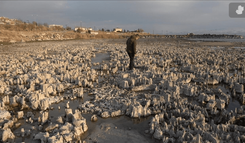
On the shores of Lake Van, where water has receded due to drought, stalagmite-like formations known as “underwater fairy chimneys”—called microbialites—have begun to appear.
In Lake Van, Türkiye’s largest lake—referred to by locals as a “sea”—rising temperatures have led to excessive evaporation and decreased precipitation, causing a drop in water levels. According to DSİ (State Hydraulic Works) data, the lake has reached its lowest water level in the past 20 years. Along the Erciş, Edremit, and Gevaş shores, microbialites that took thousands of years to form, as well as some structures, have emerged.
Nature enthusiasts and photography lovers visiting the area tried to capture images of the microbialites, which were previously visible only underwater but have now come to light due to the recession.
“We currently observe a 7.64 square kilometer recession in Lake Van”
Dr. Mustafa Akkuş, a faculty member at Van Yüzüncü Yıl University, Faculty of Fisheries, who conducted inspections in areas where microbialites are visible, said that Erciş Bay is among the locations where the recession is most pronounced.
Comparing satellite images recorded in 2010 with current data, Akkuş noted that areas once covered by water have now turned into land:
“We currently observe a 7.64 square kilometer recession in Lake Van. It is December, and precipitation levels are below seasonal averages. January, February, and March are the months when the basin typically receives heavy snowfall, which is vital for Lake Van. We hope that precipitation will increase in the coming months and that the areas exposed will once again be covered by water.”
Akkuş added that many piers and historical structures have emerged along the receded shores, and that microbialites—whose formation spans thousands of years—have also been affected by drought.
Explaining that microbialites at different points around Lake Van have surfaced due to the recession, Akkuş continued:
“Lake Van is the world’s largest soda lake. Its extreme water quality leads to the formation of unique structures we call microbialites. As the water recedes, areas composed of microbialites near the shoreline have emerged. It feels as if you are walking through a city made up of miniature skyscrapers. A microbialite just one centimeter tall forms over a thousand years. The world’s largest microbialites are currently found in Lake Van, some exceeding 40 meters in height. We can now see these living corals on land. As long as Lake Van exists, these formations will remain—they are not in danger of disappearing. Previously, we could observe them only underwater; now we can also see them on land. They are visible across many areas. These rare formations need to be brought to public attention.”
“Our region has been negatively affected by global warming”
Ayhan Şahna, Regional Director of DSİ 17th Region, stated that the region has been adversely affected by global warming, saying:
“We can see this in the water dynamics of Lake Van as well. Over the past two years, there has been a decrease of around 65 centimeters in water levels. Naturally, since we have not received sufficient precipitation during winter months, we are unable to adequately store water in our reservoirs.”
Photographer Sedat Karatay, who came to the region to take photos, said:
“We knew that the world’s largest microbialites are in Lake Van. As the water receded, they emerged. We took this opportunity to photograph these unique structures. These areas need to be protected. We captured many different and beautiful photographs.”