
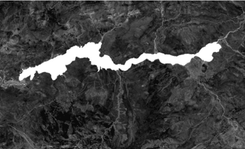
Global warming and the resulting drought continue to affect the region. In Van, the drought has become visibly apparent as precipitation has decreased over the past two years, causing many ponds to dry up during the summer months, stream flow rates to decline, and water levels in reservoir lakes to fall to critical lows. As a result of the drought, the surface areas of reservoir lakes in the basin have shrunk significantly. This reduction has also been reflected in satellite images.
LOW PRECIPITATION, HIGH EVAPORATION
Dr. Mustafa Akkuş, a faculty member at Van Yüzüncü Yıl University, Faculty of Fisheries, stated that the effects of hydrological drought—defined as the reduction and deficiency of surface and groundwater caused by prolonged lack of precipitation—have been strongly felt in the Lake Van Basin.
Noting that the Lake Van Basin is a closed basin that receives water through snow and rainfall and loses water through evaporation, Dr. Akkuş said:
“However, when we examine evaporation and precipitation values in the reservoir lakes, we see that evaporation has exceeded precipitation significantly, especially since 2020. This is why reservoir lakes are gradually receding. We have observed good snowfall in the basin in recent days, but temperatures are often above seasonal averages. We are currently in the middle of winter, yet just recently it rained in Van. In other words, rain is falling during a season when snowfall should occur. This indicates above-normal air temperatures. For the region, snowfall is crucial, because rain quickly turns into runoff and flows into the lake, whereas snowfall acts like a reservoir, remaining on mountain peaks and waiting for the summer months.”